Breakthrough in BEV Manufacturing: Expora Founders Develop Bioengineering Technology for 66-fold Increased BEV production Rates
January 24, 2026
Manufacturing Breakthrough Enables Mass Production of Bacterial Extracellular Vesicles for Gut Health Applications
College Park, MD – Researchers at the University of Maryland have achieved a major biomanufacturing breakthrough that transforms bacterial extracellular vesicles (BEVs) from a promising but impractical therapeutic platform into a commercially viable technology for improving gut health.
The team, led by Dr. Steven Jay and Dr. Nicholas Pirolli from the Fischell Department of Bioengineering, has successfully engineered a strain of beneficial bacteria that produces therapeutic nanovesicles at rates 66 times higher than conventional methods. The research, published in Advanced Science, solves a critical production yield problem that has limited the field for years and opens the door to developing BEV-based treatments for multiple gut-related conditions.
Solving a Critical Manufacturing Challenge
For years, researchers have recognized the therapeutic potential of BEVs—tiny membrane-enclosed packages naturally secreted by bacteria that can deliver bioactive molecules to human cells. BEVs from beneficial probiotic bacteria show promise for improving gut barrier integrity, modulating immune function, and promoting tissue repair. However, prohibitively low production yields have prevented their development as therapeutics.
"The fundamental problem was that bacteria naturally produce very small amounts of these vesicles," explained Dr. Jay. "Even with optimized culture conditions, yields were far too low to support clinical development or commercial production. We needed an order-of-magnitude improvement, not just incremental gains."
Engineering Bacteria to Hyperproduce Therapeutic Vesicles
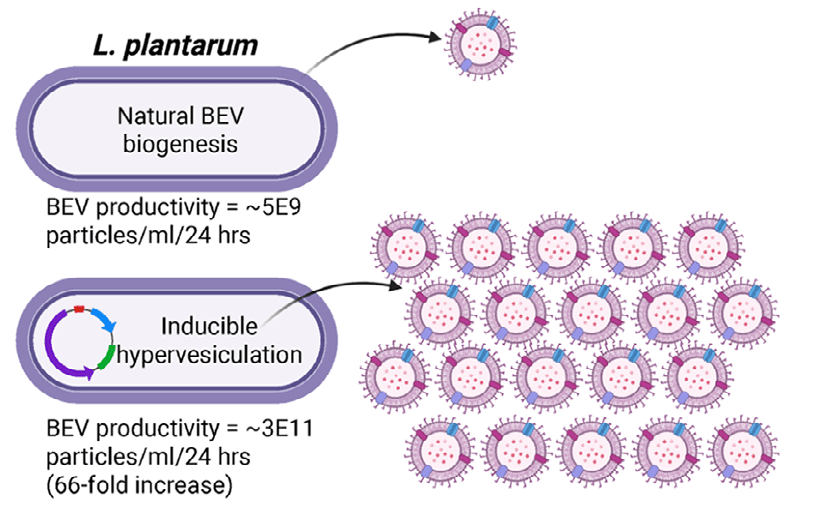
The research team focused on Lactiplantibacillus plantarum, a well-studied probiotic bacterium with established safety and efficacy in human use. The breakthrough came through genetic engineering—programming the bacteria to dramatically increase vesicle production on demand.
The team designed a genetic circuit that allows controlled expression of a peptidoglycan-modifying enzyme. When activated, this enzyme triggers "hypervesiculation"—essentially giving the bacteria the ability to mass-produce therapeutic vesicles at precisely the right time in the production process.
The manufacturing improvements were dramatic:
66-fold increase in production rate compared to conventional methods
Significantly improved product purity, reducing downstream purification requirements
Scalable and controllable process suitable for commercial manufacturing
"This isn't just an incremental improvement," explained lead author Nicholas H. Pirolli. "We've solved a fundamental biomanufacturing problem that has held back the entire field of bacterial vesicle therapeutics. This technology makes commercial-scale production feasible for the first time."
Therapeutic Potential for Multiple Gut Health Conditions
Beyond solving the manufacturing challenge, the study validated that the engineered BEVs retain their therapeutic properties. Testing in preclinical models demonstrated multiple beneficial effects on gut health:
Gut Barrier Protection: The vesicles significantly reduced mucosal tissue damage and promoted intestinal barrier integrity—critical functions for preventing and treating various gut-related diseases.
Immune Modulation: BEVs modulated immune responses without broadly suppressing the immune system, reducing inflammatory markers by up to 90% while potentially allowing patients to maintain normal protective immunity.
Tissue Repair: Treated subjects showed markedly improved tissue healing compared to both untreated controls and live probiotic bacteria.
The therapeutic mechanisms suggest potential applications across multiple conditions:
Inflammatory Bowel Disease (IBD): Including ulcerative colitis and Crohn's disease, which affect over 6 million people worldwide
Necrotizing Enterocolitis (NEC): A devastating intestinal disease in premature infants
Other gut barrier disorders: Conditions involving compromised intestinal integrity and inflammation
In comparative studies, the BEVs showed equal or superior efficacy to commercially available probiotic formulations and FDA-approved treatments for inflammatory bowel conditions.
Advantages of the BEV Approach
BEVs offer several advantages over both traditional pharmaceuticals and live probiotic bacteria:
Natural Delivery System: BEVs are naturally evolved packages that bacteria use to communicate with host cells, potentially enabling more efficient delivery of therapeutic molecules to the gut lining.
Multi-Mechanism Action: Unlike single-target drugs, BEVs can simultaneously:
Promote intestinal barrier repair
Reduce oxidative tissue damage
Modulate immune responses
Deliver beneficial metabolites and bioactive molecules
Stability and Safety: BEVs show stability in gastrointestinal conditions and lack the variability and colonization concerns associated with live bacteria.
Manufacturing Control: The genetic engineering approach enables precise, reproducible, and scalable production—critical for regulatory approval and commercial viability.
"These vesicles appear to work differently and more efficiently than their parent bacteria," Dr. Jay noted. "They deliver concentrated therapeutic cargo directly to intestinal cells without the complications of using live microorganisms."
Path Forward
The manufacturing breakthrough opens multiple avenues for development:
Immediate Applications: The team is conducting additional preclinical studies for IBD and NEC, focusing on optimal dosing, long-term safety, and efficacy in chronic disease models.
Platform Technology: The genetic engineering approach can potentially be applied to other beneficial bacterial strains, creating a versatile platform for producing BEV therapeutics targeting different conditions.
Combination Potential: Early results suggest BEVs may work synergistically with existing treatments, offering potential as both standalone and combination therapies.
Preventive Applications: Beyond treatment, the gut health benefits suggest potential use in disease prevention, particularly in high-risk populations.
The technology positions BEVs as a commercially viable therapeutic platform for the first time, with manufacturing economics that could support widespread clinical use.
This work was supported by the National Institutes of Health, the U.S. Department of Veterans Affairs, and the Maryland Innovation Initiative. The findings represent a collaboration between the University of Maryland's Fischell Department of Bioengineering, the University of Maryland School of Medicine, and the Veterans Affairs Maryland Healthcare System.
About the Research
The study, "Genetically-Programmed Hypervesiculation of Lactiplantibacillus Plantarum Increases Production of Bacterial Extracellular Vesicles with Therapeutic Efficacy in a Preclinical Inflammatory Bowel Disease Model," was published in Advanced Science in 2025.
Media Contact:
Nicholas Pirolli, PhD, CSO: npirolli@exporatx.com
Disclaimer: This research is in preclinical stages. The treatment described is not yet available for patient use and has not been evaluated by the FDA.